Flags · planted in the open

The result, planted in public

Each flag is a real, open problem worked in the open — the result and the reasoning published and checkable, the method held back. Dated, sourced, and falsifiable. It's how serious people find us.

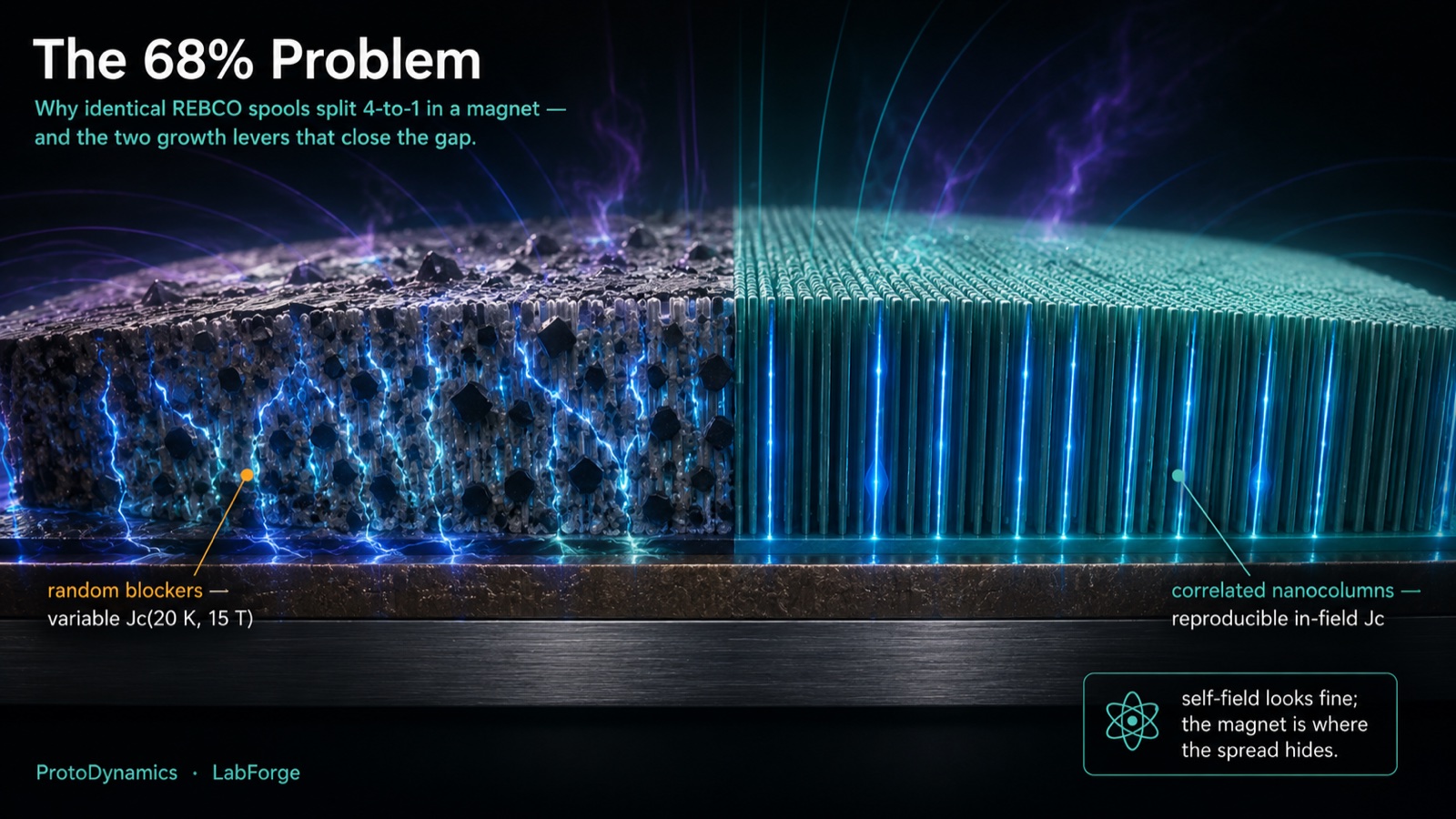
REBCO's 68% Problem

Superconductors · REBCO coated conductor · 2026-07-26

REBCO's 68% Problem

The problem

Two REBCO spools off the same line, made to the same recipe, agree to about 11% on the routine QC test (critical current at 77 K, self-field). Put them where they actually work — 20 K, 15 T, field parallel to the tape — and the same two spools can disagree by up to 68%. For a fusion magnet, kilometers of tape at 20 tesla where one weak segment can quench the whole coil, that's the difference between a magnet and a very expensive failure. The QC test run every day does not predict the magnet.

The falsifiable prediction

The same growth knob is secretly doing two jobs — a kinetic lever (arrival flux) sets the good pinning nanocolumns, a thermodynamic lever (thermal budget) governs the bad blocking-phase coarsening. Decouple them and there's a signature only a bench can produce: a growth window that cuts the blocking area fraction and raises the 20 K/15 T lift factor by ≥20%, while the 77 K self-field number stays statistically unchanged. Confirm: the magnet number moves and the QC number doesn't. Kill: area fraction drops but the lift factor doesn't follow.

Read on LinkedIn ↗
Fusion's Quiet Plasma

Fusion · plasma physics · 2026-07-25

Fusion's Quiet Plasma

The problem

Wendelstein 7-X has a "quiet" regime where turbulent transport drops sharply — and the transport that's left is microtearing. Is that quiet window a fixed limit, or a design knob you can widen? The reactor-relevant edge sits at low collisionality, so the question matters for a power plant.

The falsifiable prediction

Hold the max-J metric fixed while raising local magnetic shear at the dominant resonant surface into a bounded window — at low collisionality, and again at reactor pressure. Confirm: microtearing growth falls and survives at reactor β → the quiet window is designable. Kill: max-J can't be held, the growth rate doesn't fall, or reactor-pressure shear erases it → it's a fixed tradeoff.

Read on LinkedIn ↗
Area-selective ALD — selective film column vs re-fluorination reset

Semiconductor · area-selective ALD · 2026-07-25

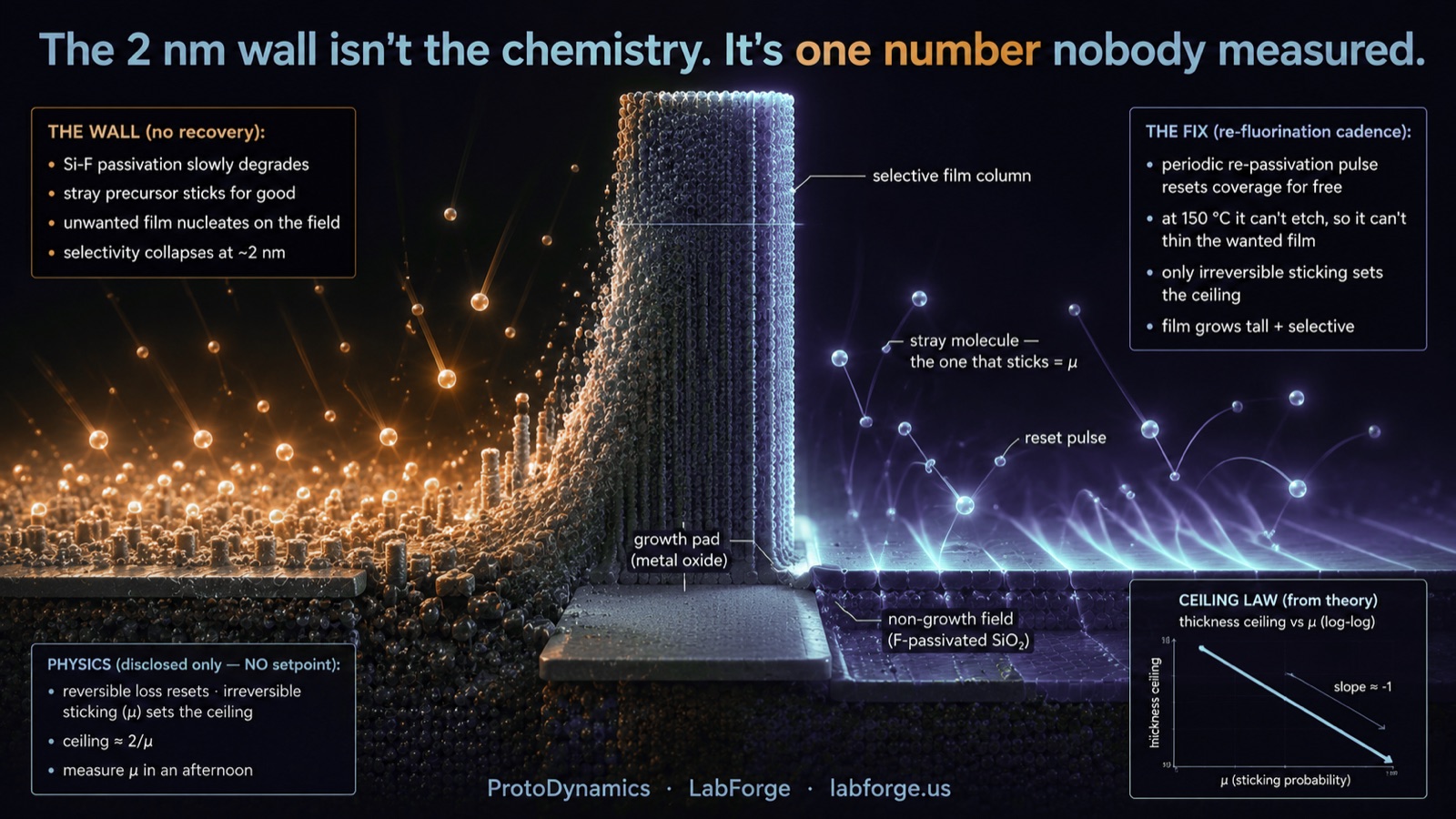
The 2 nm wall isn't the chemistry. It's one number nobody measured.

The problem

Area-selective ALD grows a film only where you want it — self-aligned vias and spacers with no mask, clawing back an alignment budget lithography can't afford. A clean 2025 TU/e demonstration passivates the SiO₂ field with an SF₆/H₂ plasma and grows TiO₂ selectively on the pads — but selectivity dies at ~2.0 nm (~57 cycles). The field's fix: periodically re-fire the plasma to etch back the stray film.

The falsifiable prediction

Half that fix is thermally dead — you can't etch TiO₂ at 150 °C, so the pulse can only re-fluorinate (prevention, not etch-back) — which also means it can't thin the film you want. The real ceiling is one unmeasured number: μ, the odds a stray precursor sticks irreversibly before the next reset → ceiling ≈ 2/μ nm. Confirm: measure μ in an afternoon (the Ti2p rise on the SiO₂ field a reset doesn't remove); μ ≤ 0.13 → a selective liner ~7× past the 2 nm wall. Kill: μ > 0.5 → it tops out near 4 nm, the 15 nm target is dead.

Read on LinkedIn ↗
The coating is MoS2, the oil makes MoS2 — one healed tribofilm

Tribology · coating + oil co-design · 2026-07-25

The coating is MoS₂. The oil makes MoS₂. Stop designing them apart.

The problem

Almost every gearbox and bearing runs in boundary/mixed lubrication — the film so thin the asperities touch, and friction is set by what forms in the contact. Yet the two things that decide it are designed by teams who never talk: one designs the surface (steel, coating), the other the oil (base stock, additives). Each optimizes their half in isolation, and the two "best" answers meet for the first time in a real contact — and usually don't cooperate.

The falsifiable prediction

Design both to make the same thing: a sputtered 2H-MoS₂ coating that seeds the film + an MoDTC oil that decomposes to the same 2H-MoS₂ and replenishes it — one self-healing tribofilm, coating solves the oil's cold-start, oil solves the coating's finite reservoir. Counterintuitive test: friction-vs-additive-dose bends the wrong way — an interior optimum, then worse (excess MoDTC oxidizes to abrasive MoO₃ that scours the MoS₂). Confirm: an MTM-SLIM sweep shows that interior minimum + over-treat rise, and the matched pair holds μ ≤ 0.04 over a micropitting-rig life while the two separate optima drift out. Kill: the curve just plateaus, or the pair shows no margin over the better single.

Read on LinkedIn ↗
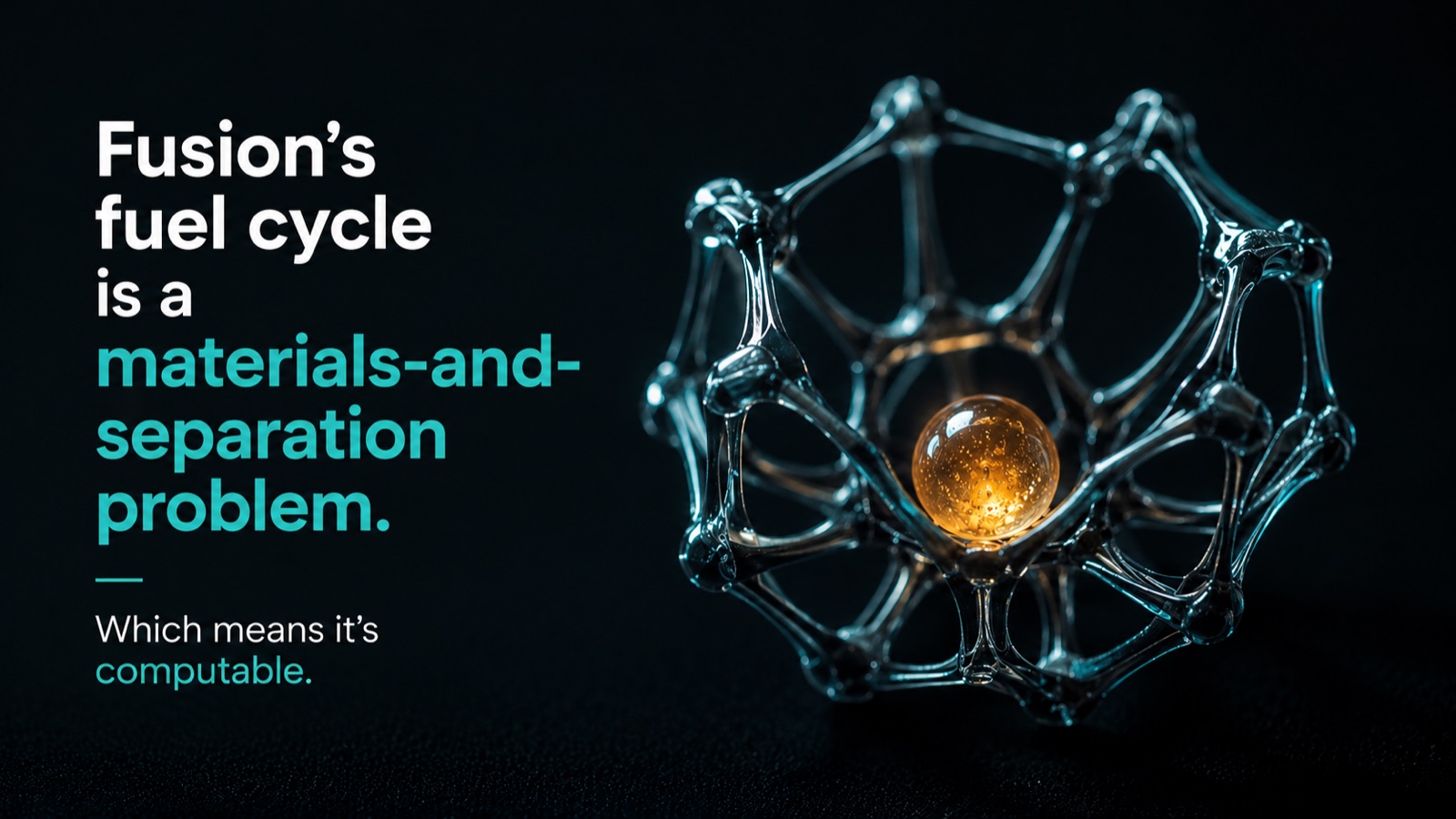
Fusion's fuel cycle is a separation problem

Fusion · isotope separation · 2026-07-24

Fusion's hardest problem isn't the plasma. It's making enough Li-6.

The problem

A D-T fusion reactor burns tritium it has to breed itself, from lithium-6 — and natural lithium is only 7.5% Li-6. Blankets need it enriched to 30–90%. The one proven route (COLEX, through a lithium–mercury amalgam) was shut down in 1963 and left one of the worst mercury sites in the country. There is no clean, scalable Li-6 enrichment in the West. That's not a plasma problem — it's a separation problem, and separation is materials science.

The falsifiable prediction

The Li-6/Li-7 separation factor is set by the binding-site geometry of the material doing the separating — computable, not luck — and the design move that raises it runs opposite to the obvious guess. Run a matched series of molecular cages with that parameter swept both ways, at fixed temperature, and measure the Li-6/Li-7 ratio in the separated fractions by mass spec. Confirm: the factor moves the way the physics predicts, against intuition. Kill: it moves the intuitive way → the model is wrong. Honest scope: COLEX-class selectivity, mercury-free — a cascade of hundreds of stages, not a magic box.

Read on LinkedIn ↗
MoS2 reproducibility — good vs failed bearing

Tribology · sputtered coatings · 2026-07-22

MoS₂ reproducibility is a process-control problem, not a metrology one

The problem

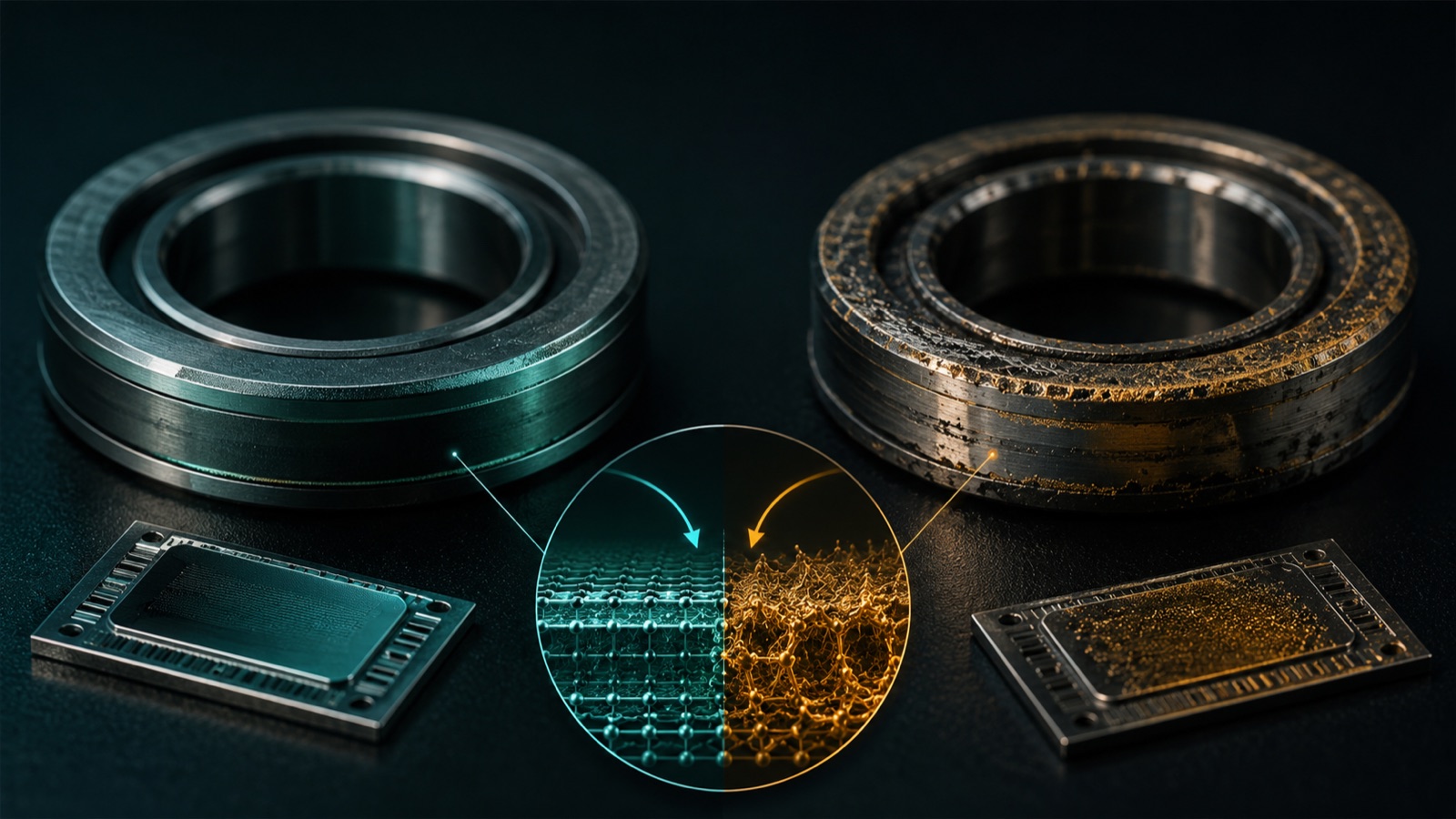
Sputtered MoS₂ is the benchmark solid lubricant for space and vacuum mechanisms — yet two films grown at identical settings can differ by 28× in wear life. The field's answer is to qualify every batch and cull the failures: detection, not control. It treats the variance as intrinsic to the material. It isn't — the outcome is decided in the first few nanometers by three variables left to drift: target-conditioning state, ppm-level chamber H₂O/O₂, and sulfur delivery.

The falsifiable prediction

Pin those three — gate nucleation-stage ion energy inside a bounded low-energy window, meter a controlled trace-oxygen dose near the friction minimum, fix sulfur delivery — and the coin flip becomes deterministic. Run one split-batch factorial (nominal vs gated × oxygen on/off) on the group's own tools. Confirm: density and hardness spread collapse below ~10%, the 28× wear-life spread falls under 3×, S:Mo ≥ 1.9, at μ_dry ≤ 0.04. Kill: any one of those missed. ~1 week, a few thousand dollars.

Read on LinkedIn ↗
lambda-MnO2 ion sieve — dissolving undoped vs Ti-stabilized

Lithium separation · DLE sorbent · 2026-07-19

Keep the selectivity. Fix the durability.

The problem

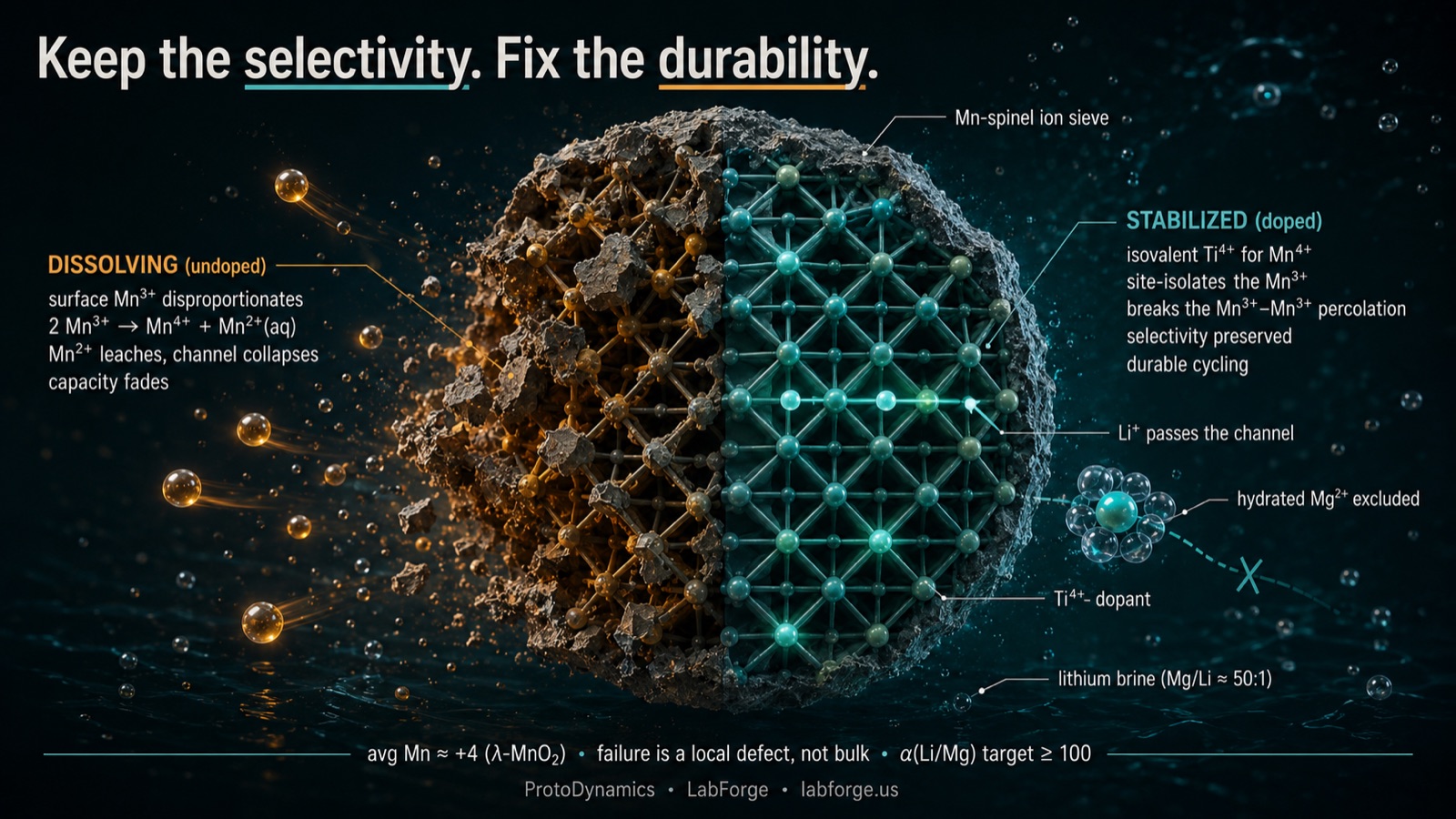
Direct lithium extraction comes down to one material: a sorbent that pulls Li⁺ from brine that's 50–100× everything else (Mg²⁺, Na⁺, Ca²⁺). The spinel λ-MnO₂ ion sieve has the size-exclusion selectivity aluminum sorbents can't touch — but it dissolves over cycles, so the field keeps switching classes. Wrong move: it fails locally, by Mn³⁺ disproportionation (2 Mn³⁺ → Mn⁴⁺ + Mn²⁺(aq)) — the soluble Mn²⁺ leaches and the selective channel collapses.

The falsifiable prediction

Substitute a small isovalent fraction — Ti⁴⁺ for Mn⁴⁺ — to site-isolate the residual Mn³⁺ and break the Mn³⁺–Mn³⁺ percolation disproportionation needs. One specific single-phase composition is predicted to thread three fighting constraints at once: α(Li/Mg) ≥ 100, ≥ 85% capacity over 20 acid-strip cycles, ≤ 5% cumulative Mn loss. Confirm/Kill: 10 g H-form sieve vs synthetic Salton-Sea brine (Mg/Li ≈ 50:1), 25 °C, ICP-OES every strip, XRD at cycles 1/5/10/20 — miss any one of the three numbers and it's falsified, in three weeks.

Read on LinkedIn ↗
Phase-plate charging — insulator charges vs leaky a-C relaxes

Electron optics · cryo-EM phase plate · 2026-07-18

Maybe the fix for phase-plate charging is a leaky insulator — not a conductor.

The problem

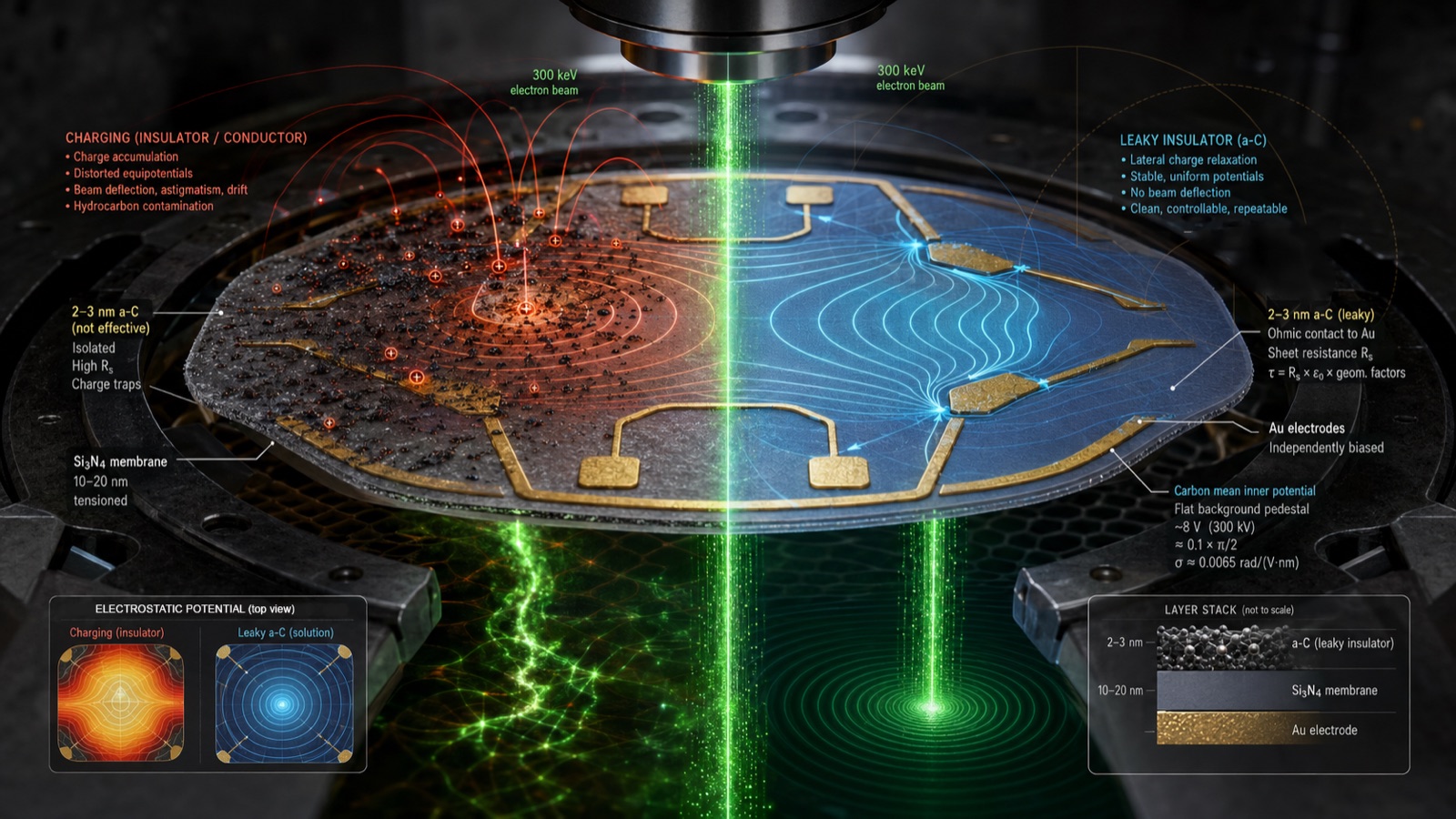
Tunable electrostatic phase plates — chips you bias with a software slider to dial phase-contrast into cryo-EM — hit a wall that's pure materials science: put an insulating membrane in a 200–300 keV beam and it charges like a capacitor, acting as a stray lens (drift, astigmatism). The reflex is a conductive anti-charge layer — fatal for an electrode array: a good conductor shorts the independently-biased electrodes and erases the field.

The falsifiable prediction

The right target is the opposite of the instinct — a leaky insulator: a static-dissipative ~2–3 nm low-stress evaporated a-C layer in a narrow sheet-resistance window, resistive enough to keep electrodes isolated, conductive enough to bleed beam charge to ground faster than a frame time. Confirm/Kill: 4-point R_s on a witness coupon (a falling R_s over bake = dewetting failure), sub-pA inter-electrode leakage at bias, and <1-pixel charging drift over 60–120 s of irradiation. Dose-correlated drift → R_s too high; instant t=0 distortion → too low.

Read on LinkedIn ↗
Sonoluminescence ring-down — the floor where it refuses to fade

Cavitation · sonoluminescence · 2026-07-17

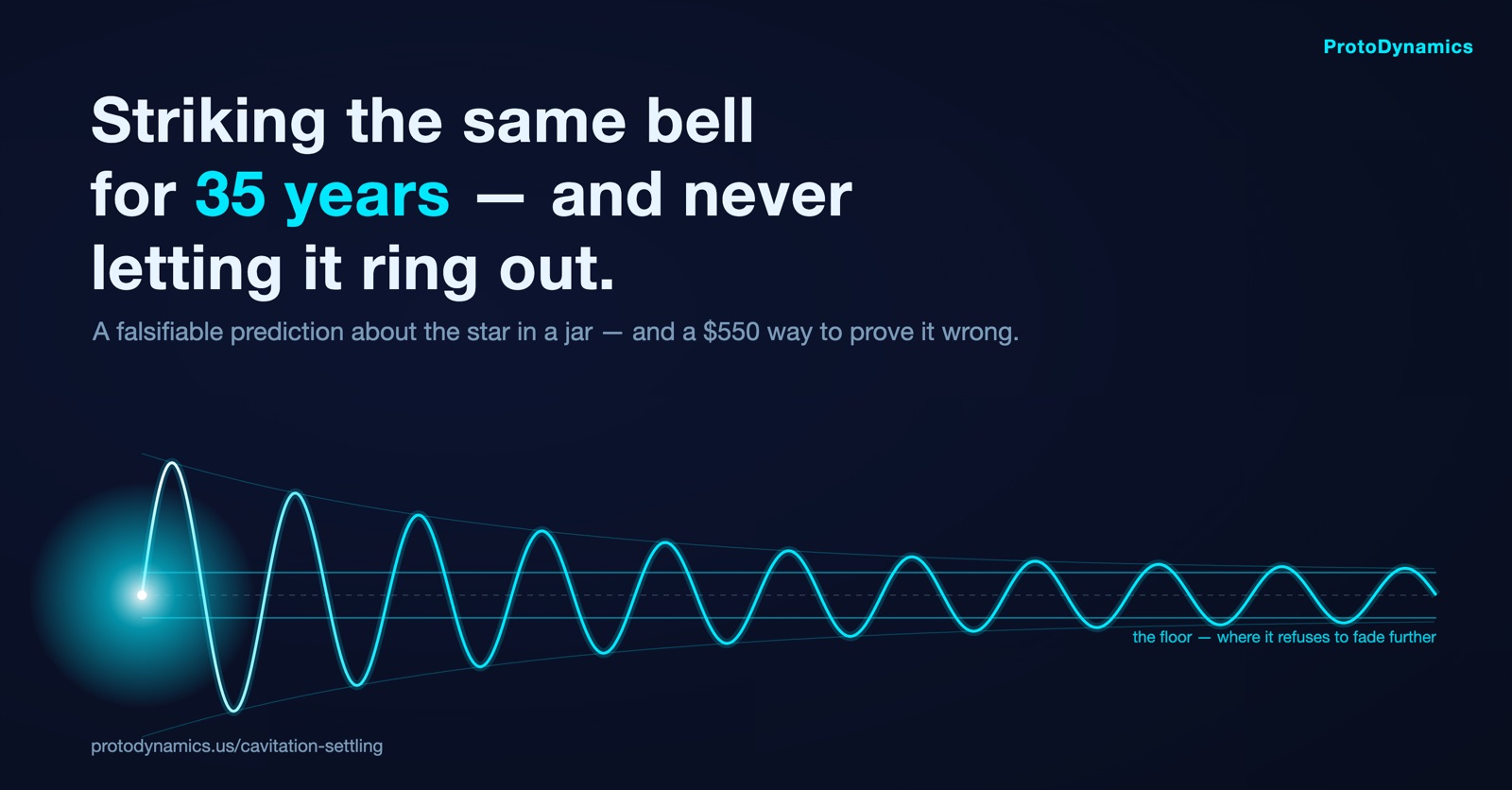
Physics has been striking the same bell for 35 years — and never let it ring out.

The problem

Since 1989, a single bubble trapped in water by sound collapses once per cycle and flashes light from gas hotter than the sun — sonoluminescence. Everyone stares at the flash. But watch after: the bubble rings down in ever-smaller rebounds. The field treats that tail as featureless noise. The trap: the same sound that makes it flash grabs it for the next flash — so in 35 years of data the bubble has never once been allowed to settle all the way down. The drive that creates the effect is the same drive that hides its ending.

The falsifiable prediction

Cut the sound at the flash and let it ring down freely for the first time. Textbook says it decays smoothly to nothing. Prediction: the ring-down stops — reaches a floor and plateaus — at about 21 nm of residual motion for the canonical bubble (~40 nm in cold argon). Kill: the bubble sails smoothly through 21 nm with no floor → wrong, publicly. The rig is a standard single-bubble cell + a fast switch to kill the drive at the flash — about $550 in parts.

Read on LinkedIn ↗
Li3ScF6 coating — patchy sol-gel vs conformal ALD

Solid-state battery · cathode coating · 2026-07-13

The right coating. The wrong way to put it on.

The problem

Li-rich Mn cathodes are among the highest-energy and most fragile options for solid-state batteries — lattice-oxygen release and interfacial side reactions fade them fast. A 2026 USTB paper solved the chemistry with a Li₃ScF₆ protective layer (an Sc–O bond stabilizes the oxygen lattice; the fluoride shell suppresses side reactions). But it's deposited by sol-gel — a wet route that can't control the two things a cathode coating lives or dies on: full conformal coverage and nm-scale thickness.

The falsifiable prediction

Deposit the same Li₃ScF₆ by dry powder ALD at the ~5 nm optimum (TiF₄ route, no HF), then run symmetric-cell EIS head-to-head against the sol-gel film — same cathode lot, same electrolyte, EIS every 50 cycles to 500. Confirm: dry-ALD starts ≥ 30% lower charge-transfer resistance and the gap widens with cycling — patchy sol-gel degrades preferentially while the conformal shell ages uniformly. Kill: the curves converge, or ALD ever runs higher → coating bulk resistance is winning, not coverage.

Read on LinkedIn ↗
Li2ZrO3 cathode coating — Li+ through, electrons blocked

Solid-state battery · cathode coating · 2026-07-13

They optimized the composition. The bigger lever was the thickness they held fixed.

The problem

The coating on a Ni-rich NCM811 cathode has one of the hardest jobs in the cell: a selective barrier — wide open to Li⁺, closed to electrons. A 2026 Hanyang/Samsung paper swept the coating's composition and showed Li₂ZrO₃ (2:1) wins — a clean, useful result. But every version was deposited at a fixed ~9.8 nm, and thickness was never varied. That's the open axis.

The falsifiable prediction

Coating thickness is a bathtub, not "thinner is better": coverage completes over a few nm while ionic resistance and stored strain rise with thickness — putting the optimum near 5–6 nm, ~40% thinner than 9.8 nm. Run a 2×2 (composition × thickness) on identical cells. Confirm: 2:1 at 5.5 nm holds coating-ASR ≤ its 9.8 nm control, lifts first-cycle efficiency ≥ 84% and retention ≥ 83%, with no rise in electrolyte-decomposition signature. Kill: thinner improves ASR but worsens efficiency/retention → you've dropped below the pinhole floor.

Read on LinkedIn ↗
BaZrS3 chalcogenide perovskite — large-grain film growth

Photovoltaics · chalcogenide perovskite · 2026-07-13

BaZrS₃ at device quality: the one-minute limit is plumbing, not chemistry.

The problem

Chalcogenide perovskites like BaZrS₃ are a leading lead-free absorber for tandem PV — near-ideal band gap, strong absorption, real stability, all Earth-abundant. The one thing between them and devices is the growth. A 2026 Uppsala result cracked the hard part — a solid barium polysulfide (BaS₃) drives flux-free nucleation — but its best condition held for only ~1 minute before the sulfur source depleted, truncating growth. It's read as a fundamental limit.

The falsifiable prediction

It's not chemistry — it's source architecture (sulfur condensing on cold walls, the boat cooling). Sustain the window (dual-boat feed / metered CS₂), drop the reactive SnS cap, stage the thermal budget, and never let it go sulfur-poor — because the whole route hinges on one claim: the sulfur vacancy is the dominant donor. Confirm: Hall carrier density vs sulfur partial pressure at fixed temperature gives a −1/6 log-log slope (the Kröger-Vink fingerprint of a double-donor vacancy). Kill: a flat response → transport is set by something else. One curve settles it.

Read on LinkedIn ↗

What was left out

Each of these is missing one thing, on purpose.

Every flag ships the reasoning, the mechanism, and the test that settles it. What none of them ships is the reconciled operating point — the specific window that makes it work on a given tool. That is the part that takes the work to find, and it is the part we keep.

If you work in one of these fields and you want the full scope on one of them — including what was deliberately withheld, and the result carried through to your own hardware — reach out and we will discuss it directly, under NDA where it matters.

Discuss the full scope ↗